Late Spring
Scuppers Ready For Storms
Clearing crusted scuppers and drains before summer keeps storm water off dock lines and wall flashing.

Industrial roof repair in Yuma, planned in sections around exhaust stacks, dust collectors, condensers, and the plant schedule.

Large plant roofs rarely fail all at once. Section repairs keep a plant running while the worst areas get fixed first.
Industrial roofs carry equipment that other roofs never see. These pairs link what plant staff notice to the roof detail behind it.
Water landing near a line usually traces to a curb or penetration directly above the equipment it serves.
Fan and stack curbs crack at corners as heat and vibration work the flashing loose.
Frost or drips at cold-room panel joints point to warm, moist air getting into the roof assembly.
Blisters and soft spots near curbs show where that air reached the cold side and turned to water.
Fine dust falling inside near a collector can mean the roof penetration around its duct has opened.
Residue from collectors and process vents softens some membranes, so the area gets cleaned and checked before any patch.
Wet floors by dock doors usually trace to the roof edge or a scupper above the dock line.
Sand-crusted scuppers hold water at the roof edge, where it soaks into the wall flashing.
A warmer, damp-smelling area under part of the roof suggests wet insulation in that section.
Foot traffic around condensers wears membrane thin where technicians walk without pads.
Industrial repairs follow the equipment on the roof. These are the repairs we plan most often on Yuma plants and cold storage buildings.
| Problem | What We Do | How It Gets Scheduled |
|---|---|---|
| Curbs at stacks and fans | Rebuild curb flashing with heat-tolerant detailing and seal the counterflashing | With lockout set by plant staff |
| Residue-damaged membrane | Clean the residue, check the membrane, then patch or replace the affected section | Between shifts or during a planned stop |
| Cold-room condensation | Seal the air path through the vapor retarder along with any membrane damage | Around cooler loading and product moves |
| Worn service paths | Repair worn membrane and add walk pads along technician routes | With HVAC and refrigeration service visits |

Plant schedules and the weather both decide when roof work fits. These cards follow the Yuma year from a plant roof point of view.
Clearing crusted scuppers and drains before summer keeps storm water off dock lines and wall flashing.
Sealed vapor gaps over cold rooms limit the condensation that builds when a roof bakes above a refrigerated space.
Rebuilt curb flashing at fans and stacks keeps wind-driven rain out of the process areas below.
Packing sheds run hardest in the winter produce season, so heavier roof repairs get planned around peak harvest and shipping weeks.
Call with the equipment near the leak, such as a fan, stack, or condenser, and your plant hours. Lockout and access get planned on the first call.
Plant repairs add a planning step up front so roof work and production stay out of each other's way.
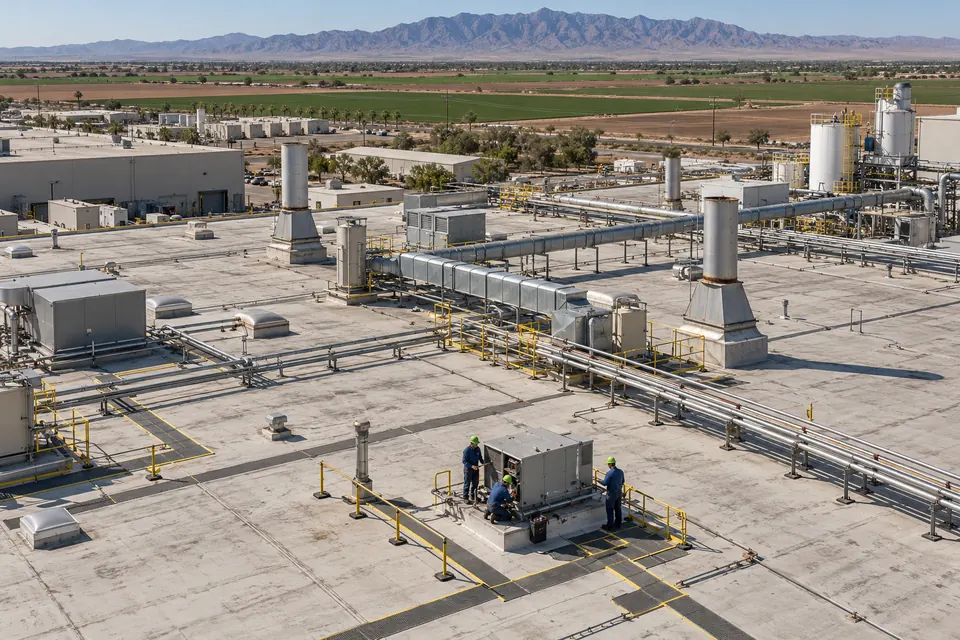
Curbs, stacks, collectors, vents, condensers, scuppers, and drains get checked, with residue and worn paths marked on the roof plan.
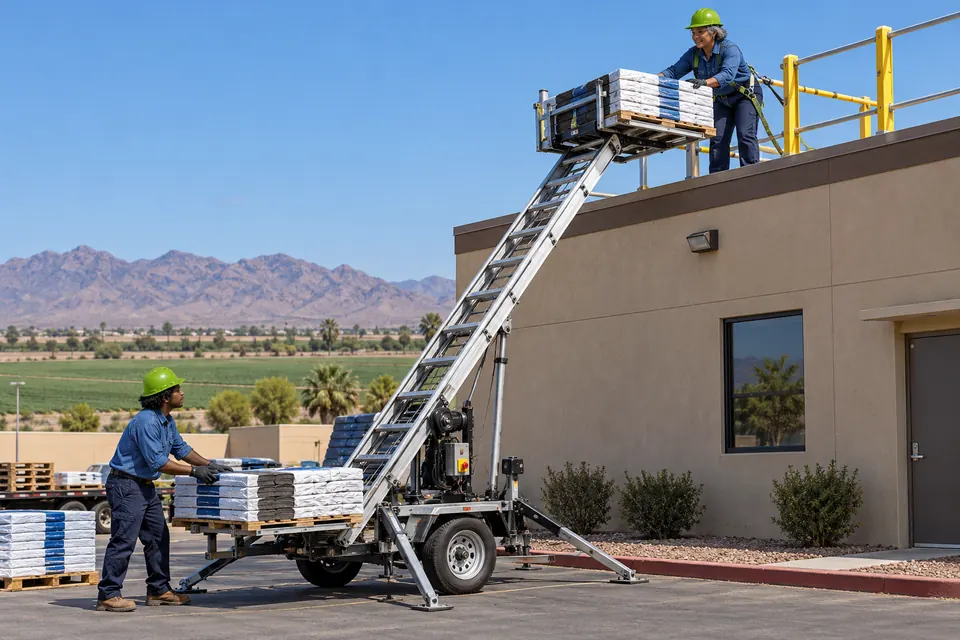
Roof access points, lift or crane needs, lockout with plant staff, and areas kept clear of docks get set before work starts.

The roof gets split into sections, so each one opens and closes within a planned window around shifts and shipments.
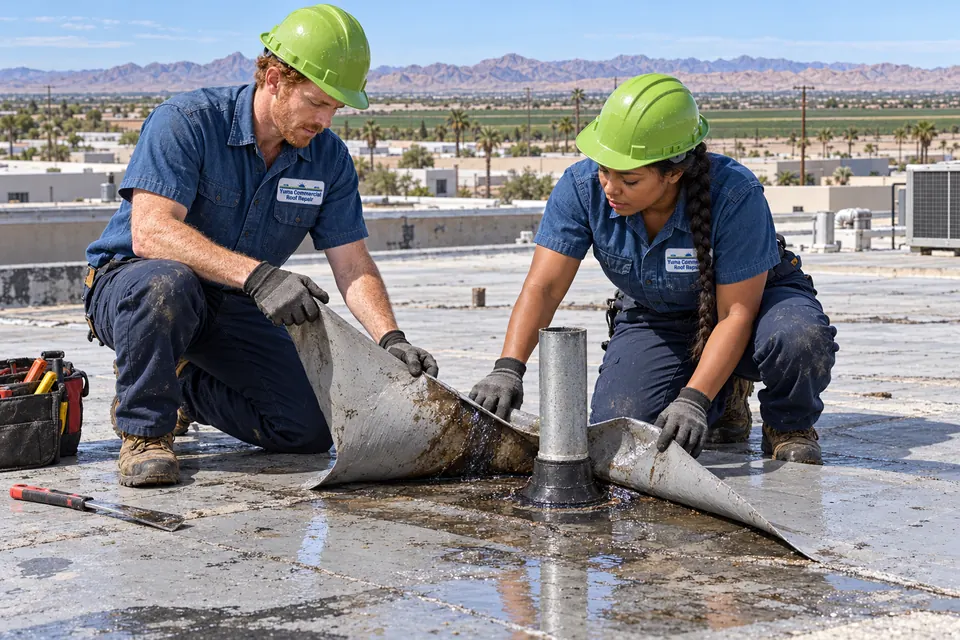
Curb flashing, residue-damaged membrane, vapor gaps, and worn paths get repaired, with materials chosen for the heat and discharge near them.
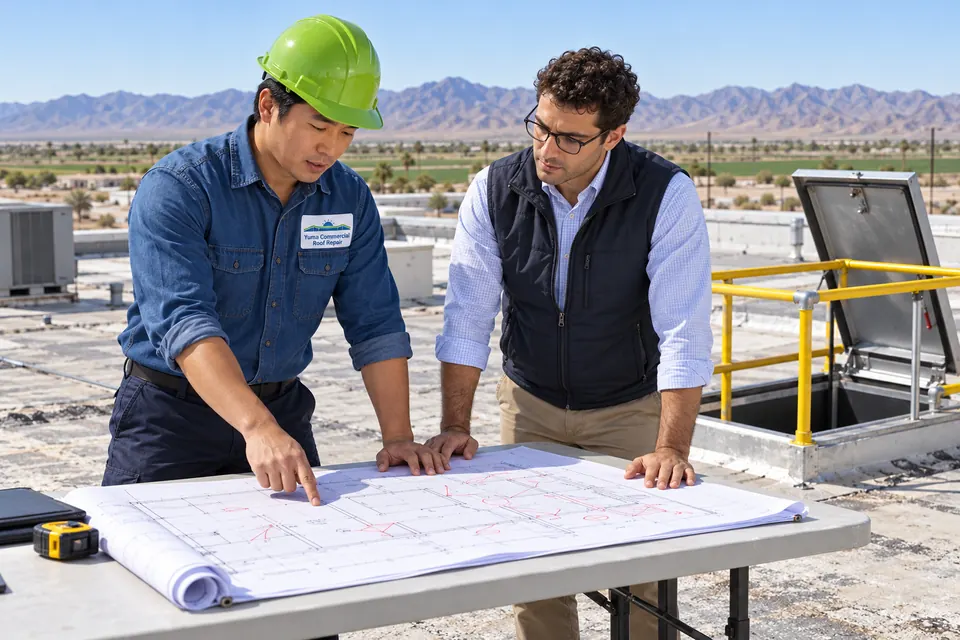
Each finished roof section gets photographed and noted, so maintenance staff know what was repaired and what to watch next.
Plant roofs often mix membrane and metal. These services cover the rest of the building.

Metal roof repair covers packing sheds and shop wings with ribbed panels, where fasteners, laps, and skylights move with the heat.
On This Repair Ticket
Flat roof repair covers the membrane sections over offices, coolers, and production bays, with seams and drains repaired in place.
On This Repair TicketAnswers about repairing roofs on plants, packing sheds, and cold storage buildings around Yuma.
Yes, by working in planned sections around the equipment and the plant schedule. Work near stacks, dust collectors, and process vents uses lockout with plant staff and avoids hot discharge.
Access points, lift or crane needs, and clear zones at the docks get agreed before work starts.
Condensation. Warm, moist air slips through gaps in the vapor retarder, meets the cold side of the roof assembly, and turns to water. A lasting repair seals that air path as well as any membrane damage.
Some process residue softens or stains roof membranes. We clean the area around each vent or collector and check the membrane under it before choosing the patch.
Yes. Western Arizona supplies most of the nation's leafy greens in most weeks from November to April, so packing-shed work is often planned for the weeks around that peak.
Plant staff control lockout on their equipment. We agree on the lockout plan, the work window, and the contact person for each section before anyone works near the unit.
Yes, along routes technicians use often. Pads spread foot traffic and protect membrane around condensers and fans, where worn spots tend to open first.
Tell us about the building, the equipment on the roof, and your schedule. We plan the repair around production and price it by section.
Leave a name and number and we will call to talk through the leak or damage.
Or call now: (928) 436-4828