Late Spring
Water Leaves By The Drain
Re-set clamp rings and cleared strainers move storm water off before it can stand against a seam or pitch pan.

Flat roof repair in Yuma for seams, drains, curbs, parapets, and pitch pans: the transitions where most commercial flat roofs start to leak.

Most flat roofs we see in Yuma still have a dry, attached field with trouble at the edges. These lists show which side of the line your roof sits on.
Each pair links a sign staff report to the flat roof transition that usually causes it, based on where Yuma flat roofs fail first.
Mid-room stains rarely sit under the leak. Water slides along the deck flutes or across insulation boards and drops at the first low point.
Daily heat cycling pulls seam laps apart over the years. A probe along the lap finds the soft spot where the bond let go.
Water falling right under a drain line points to the drain itself, where the membrane meets the drain bowl.
Clamp rings work loose and the sealant under them cracks. Re-setting the ring with fresh sealant closes that path.
Puddles near a mechanical room or unit chase usually come from the curb above, where the unit sits on the roof.
Curb flashing under HVAC and refrigeration units splits at corners as the curb and membrane move at different rates.
Damp drywall at the top of an outside wall points to the parapet above rather than the open field of the roof.
Coping joints crack and counterflashing works loose, so water gets behind the membrane at the wall.
Leaks that follow a pipe down through the ceiling usually started at the boot or pitch pan where the pipe leaves the roof.
Pipe boots shrink and pitch pans dry out in the sun, leaving a gap the next storm finds.
The repair depends on what membrane is already on the roof and how the failed area is built. These are the repairs we make most often.
| Problem | What We Do | Why It Fails Here |
|---|---|---|
| Lifted or split seam | Clean the lap, test the sheet, then re-weld or seal and cover with a matched strip | Heat cycling breaks the bond at laps first |
| Leaking drain | Pull the clamp ring, clear crusted sand, re-seal, and set new strainer bolts | Dust packs the bowl and holds water at the ring |
| Curb or wall flashing | Strip the cracked flashing and rebuild it with membrane matched to the roof | Shrinking membrane pulls away from vertical surfaces |
| Pipe boot or pitch pan | Replace the boot or refill and cap the pan with compatible sealer | UV dries out rubber and sealers at penetrations |
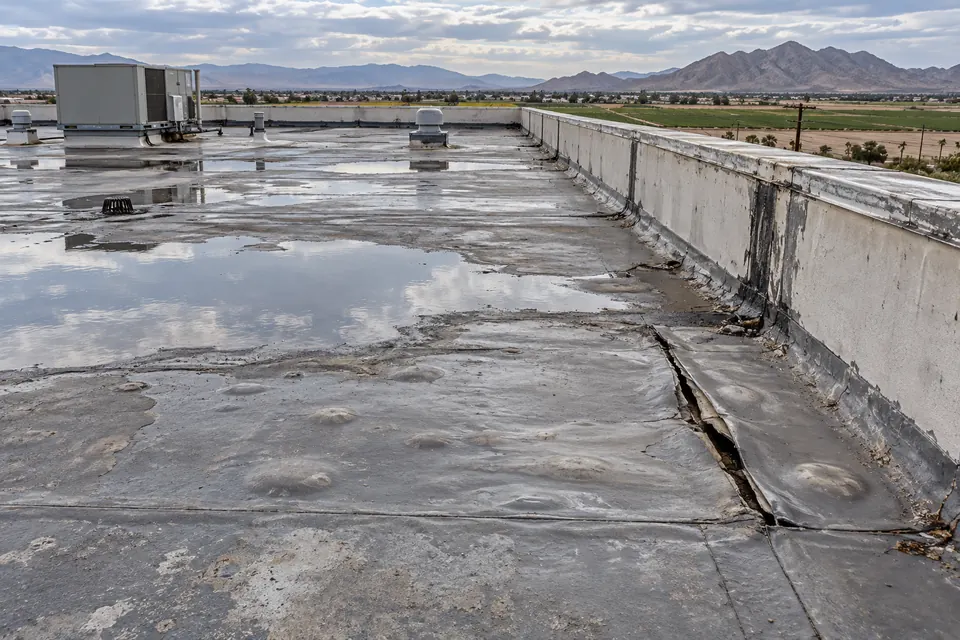
Each repair keeps one season from widening an opening on a flat roof. The cards follow the Yuma weather year.
Re-set clamp rings and cleared strainers move storm water off before it can stand against a seam or pitch pan.
Re-welded and re-sealed laps hold through afternoons that pass 110°F, when a dark flat roof runs hotter than the air.
Rebuilt parapet and curb flashing keeps wind-driven rain from getting behind the membrane during a short, heavy storm.
Cooler months are when wet insulation gets cut out and replaced, so the next summer starts with a dry roof assembly.
Call with the roof type if you know it, such as TPO, modified, or built-up, and where water is landing. We bring patch material to match.
Flat roof repairs follow the same five steps every time, from the first walk to the water test.
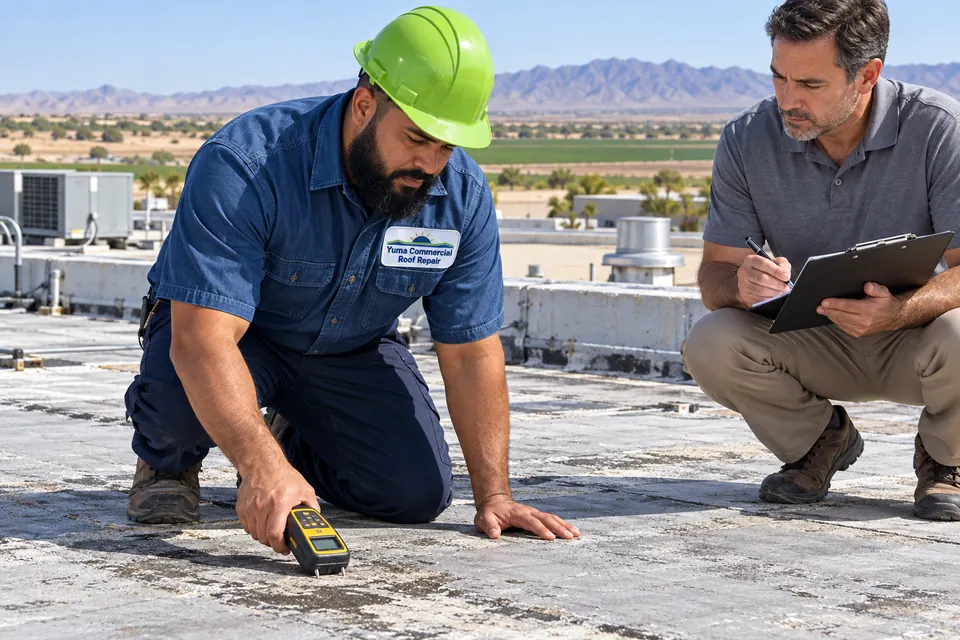
Every lap, drain, curb, pitch pan, and parapet gets walked and noted on a roof sketch, with ponding rings and blisters marked.

Probing laps and reading moisture around the suspect area separates the one failed transition from the dry field around it.
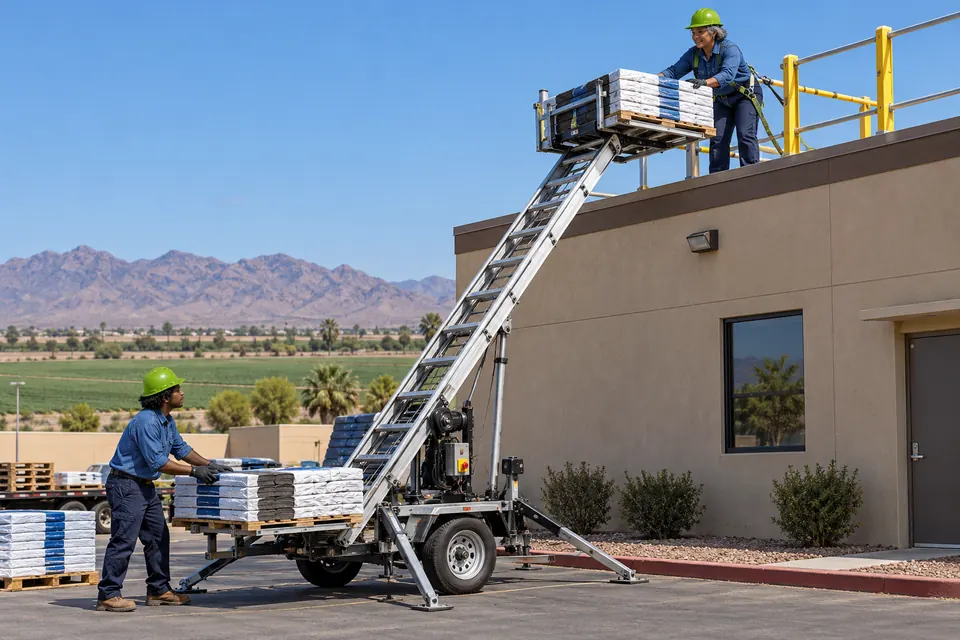
Wet insulation under the failed spot comes out. The opening gets covered at the end of each work day until it is closed.
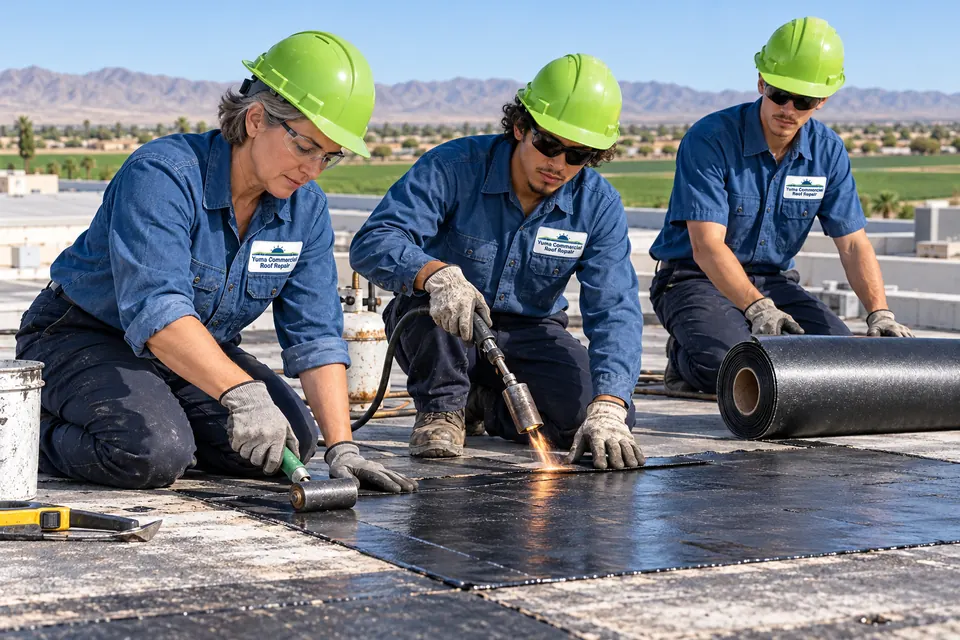
Membrane goes back to match what is there, welded, adhered, or torched as the existing roof calls for.
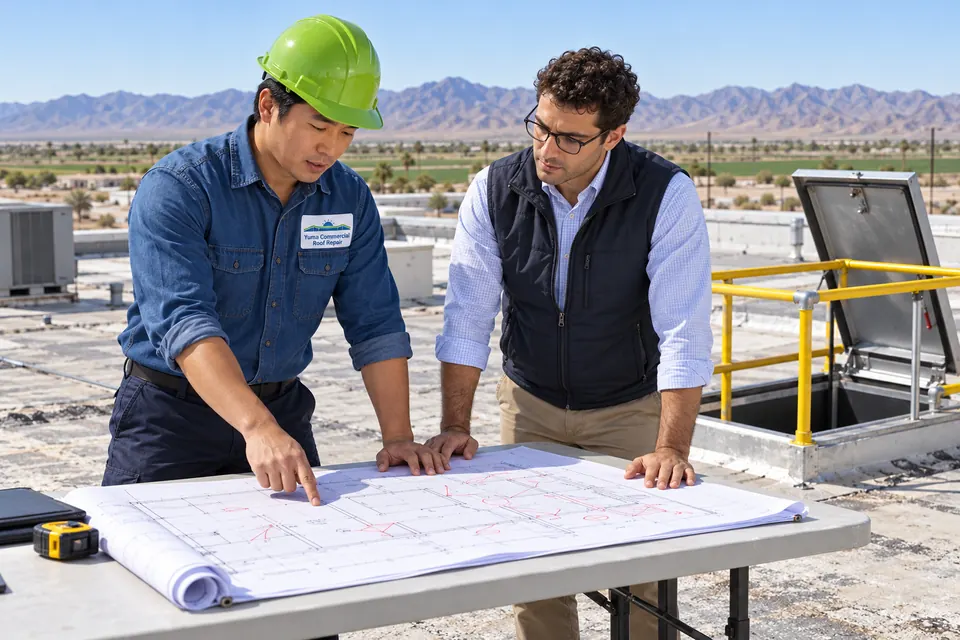
A controlled water test on the repaired lap or curb confirms it holds, and photos of each repair go to you.
Two other services come up often on flat roofs. Each card says when it applies.
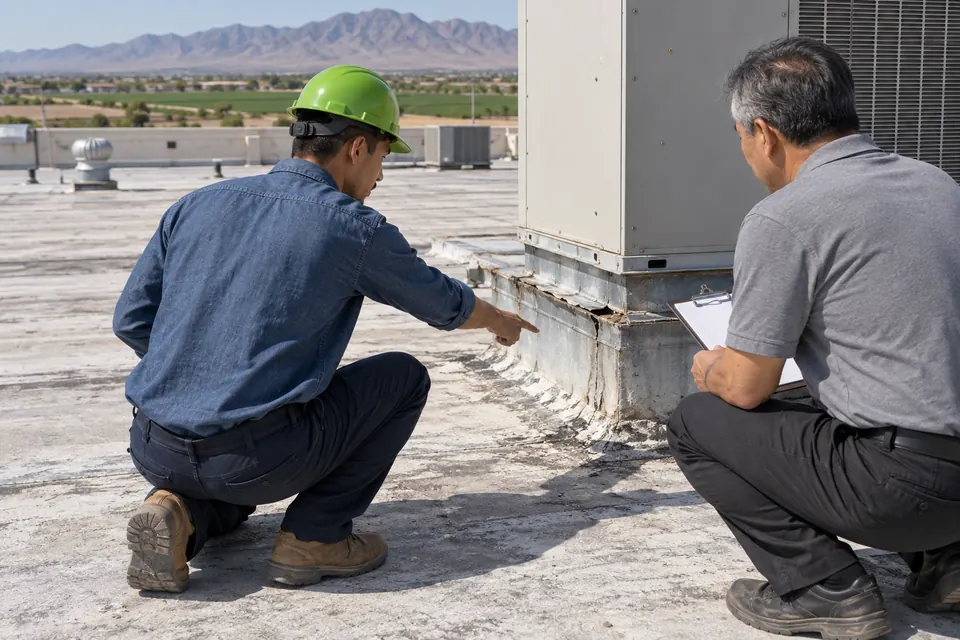
Leak tracing fits when a flat roof stain has no clear source, because water on a flat roof travels along the deck before it drips through.
On This Repair Ticket
Industrial repair fits flat plant roofs where stacks, dust collectors, or refrigeration units sit on the membrane and the work has to follow the plant schedule.
On This Repair TicketAnswers about repairing membrane, modified, and built-up flat roofs in Yuma.
At the transitions. Seams lifted by heat cycling, drains with a loose clamp ring, curbs under HVAC units, cracked parapet coping, and dried pipe boots cause most flat roof leaks.
The open field of the roof tends to outlast its edges, which is why a repair aimed at one transition so often solves the leak.
Often, yes. We clean a test area and try a weld or adhered patch first. If the aged sheet will not take the bond, the repair uses a cover strip method or the area moves to a recover discussion.
Yes. Modified bitumen gets patched with matching cap sheet, torched or adhered as the roof is built. Built-up gravel roofs get the gravel moved back, the plies repaired, and the gravel replaced over the patch.
Not by itself. Ponding that clears within a couple of days is common on older flat roofs. A sagging deck under the pond, or ponding that reaches a seam, is what moves the repair into deck work or a new roof.
As many as still bond. Once old patch layers start lifting faster than new ones stick, more patching stops paying off, and replacement planning makes more sense.
Yes. Flat roof repairs run from the roof with ladder or lift access agreed in advance. Torch work near intakes gets scheduled for hours when the units can be shut down.
Send the address and where the water shows inside. We inspect the flat roof above it and price the repair.
Leave a name and number and we will call to talk through the leak or damage.
Or call now: (928) 436-4828